I’m stuck! What should I do? Advice from new graphic recorders
A question that new graphic facilitators always ask in our courses, is “what do you do if you’re stuck?” We’ve all been there. It happens!
And I could answer this quickly with “it’s all about the planning, because we don’t just show up and draw” – but sometimes, this question is about something much deeper. It’s about getting unstuck, and staying grounded. At our graphic facilitation/graphic recording workshops, we love to ask new graphic recorders what do you do to get unstuck? and, how do you stay grounded? because the advice they give themselves and each other is more powerful than anything I could ever say. It’s crucial that you do make a wise move and get unstuck, because you have a valuable and unique role in the room. And like someone in the workshop said, remember “you’re the one brave enough to try!”
Complexity and uncertainty means there isn’t one clear answer
Graphic facilitation is about planning as much as the situation requires, and, it’s also about our confidence, trusting our skills and the group, and also firmly being okay with uncertainty. Most of our meetings and discussions are complex, so things could unfold in a multitude of ways. Even when we ask the same question, or have lots of experience, each time will be different. The answer isn’t in trying to control the outcomes, or trying to control the people in the room.
Graphic recorders, what do you do when you’re stuck?
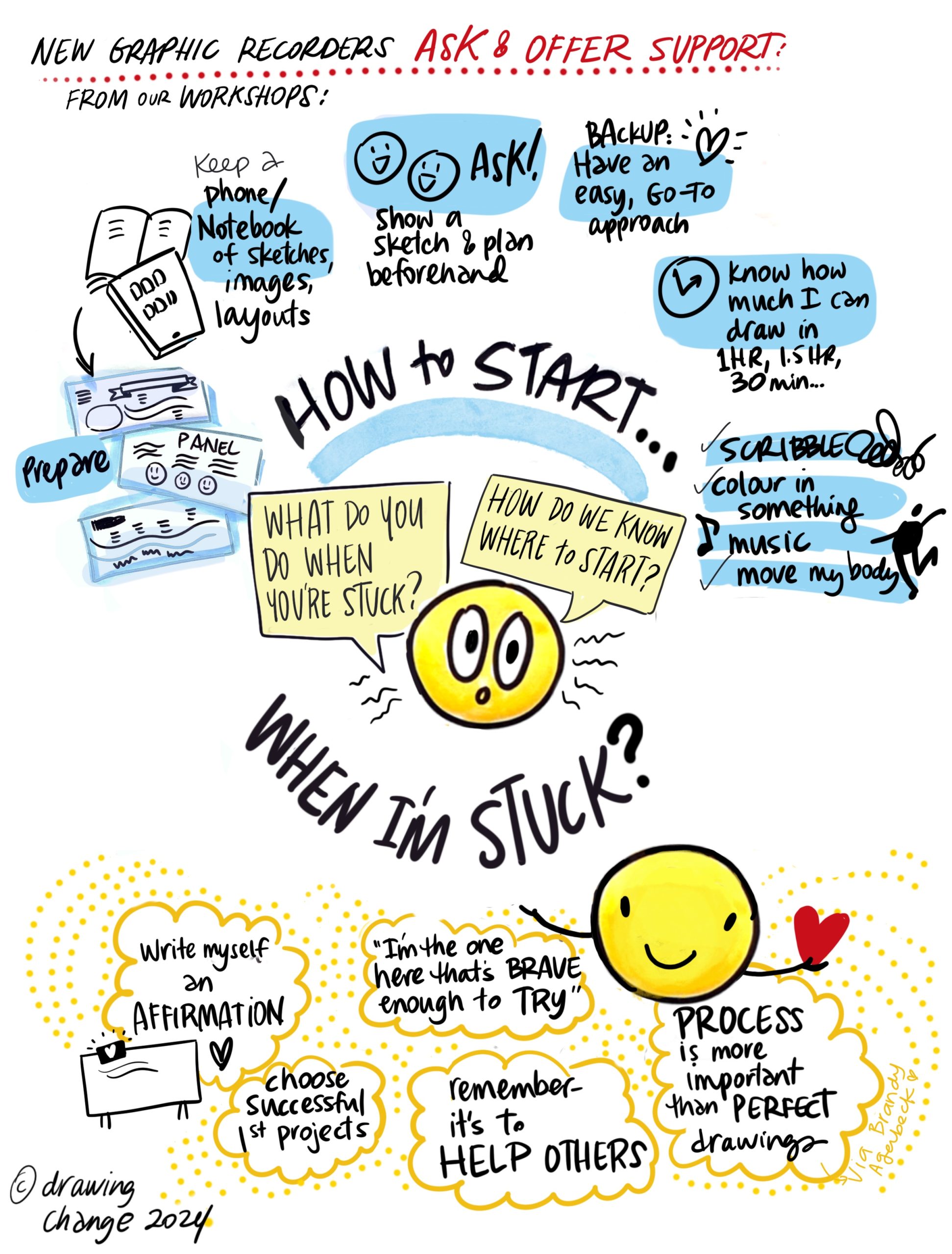
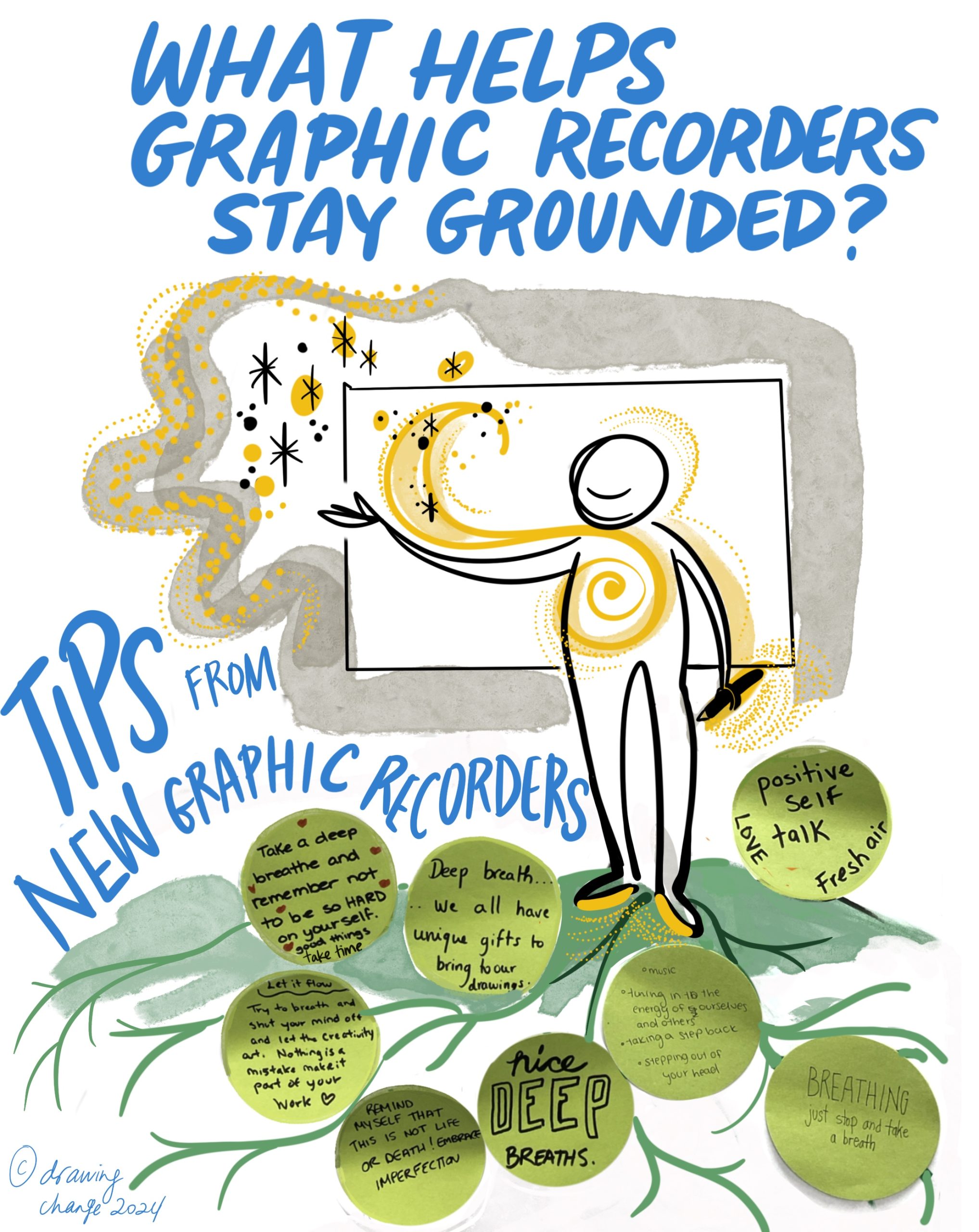
How do new graphic facilitators stay grounded? Advice to ourselves
As a graphic facilitator, staying grounded when we’re in these complex situations is key. There’s a balance for visual practitioners in knowing where we want to go with a group, while staying open to what is not-yet-knowable.
When graphic facilitators stay grounded ….
We follow the group, and we’re able to change course.
We stay grounded, even when we don’t agree.
We draw what the group means, we don’t visualize just what we hope they’ll say.
We honour the power held by the group, not just in the person holding the pen: we’re not the only one with “the right” answer.
Here’s wise guidance from new graphic recorders to themselves – and to anyone who’s doing something creative and new.
Losing my creative flow state happens to anyone creative. Managing creative flow when I’m thrown off in the moment – is about how I manage my triggers. There will be many times when I am thrown off by a hurtful comment, a stressful situation or my own anxiety, or those deeper triggers about being seen as “wrong” or ignored.
I have a variety of techniques that I am constantly working on, including deep breathing, mindfulness, and other practises so when I am thrown off, I come back to centre much faster under pressure. I’m still a beginner. But in general: breathing, noticing what is around me, naming and touching things to bring me back to center, doing my inner work about knowing myself and about tough topics (ahem, white fragility), meshing, shifting my state in the moment with movement or curiosity or even finding the funny part.
For extra context, all the tech we need for our online meetings (facilitation, graphic facilitation) is demanding at the best of times, plus the extra pressure to ‘perform’ creatively in much shorter meetings. The work requires deep listening and ultra focus – but somehow also staying connected to a bigger field at the same time.
We are our own hardest critics, and it could also be that my in-the-moment-panic/losing my groove wasn’t noticed yet by others. Maybe. Maybe not.
It is also good practice to pause. Move away from the work, and gain perspective. Zoom out. Can someone understand what is the topic by only looking at the pictures? Or the questions? Don’t get too lost in too many details/impossible perfection.
Then there’s this other part about creative work being a muscle. This longer term muscle building helps in the moment when things slip up. It used to take me hours to get ready / feel creative / get into my flow state. But now if I need to access that and draw something, I can drop Into it much easier (Oh, I still procrastinate wildly on writing though). Thanks Twyla Tharp for her book on creative practices there, including getting set up at the end of day for the next days work. Super appreciate the conversation Aaron Johannes-Rosenberg and Reilly Dow and I had about this on Twitter too.
And always, always – remember that graphic recording or facilitation or your creative practices are about being in relation. Don’t assume and guess – when we can ask for help we should ask. Ask people to help – because when we co create things, they are more meaningful and full of potential we could never do alone.
PS. In 2023, I spent so much time doing what I love: teaching. It’s such a good way for me to listen to what the broader field needs, and to hear how the questions from learners change over time. One highlight was teaching in Yellowknife, Northwest Territories for two weeks. Thought it might be fun to share some visual highlights from my sketchbook from my trip up North, and if you’re interested in our training courses head over here.