
Supporting Strong Decision Making – Consensus Skills
Why strengthen your consensus skills? Better communication! Especially when you want stronger decisions. Here’s the sneaky part: consensus doesn’t mean that everyone agrees the same amount, all the time.
Consensus resources
- what do we mean by consensus? the flow
- when consensus works
- when it doesn’t
- tool for better meetings: is it for information, discussion, or decision?
- how to use a gradient of agreement / disagreement to gather information instead of yes/no/abstain voting
- updated in 2025: a video about a gradient of agreement
Consensus 101: why? how? and when shouldn’t we?


For every meeting: is it for information, discussion or decision?
On your agendas, make better meetings by indicating if we are:
- sharing information (or making a proposal)
- having a discussion
- or making a decision

Gradients: a shortcut for stronger decision-making
Participatory decision making skills take more time. But even moving to a question like “who likes this proposal — out of five?” is a great start. It can change the way people give feedback or answers.
And online, holding up (or typing) one to five fingers to the screen for a quick visual check in is easy.
It’s not a vote, but it quickly gathers data to show where a group is at.
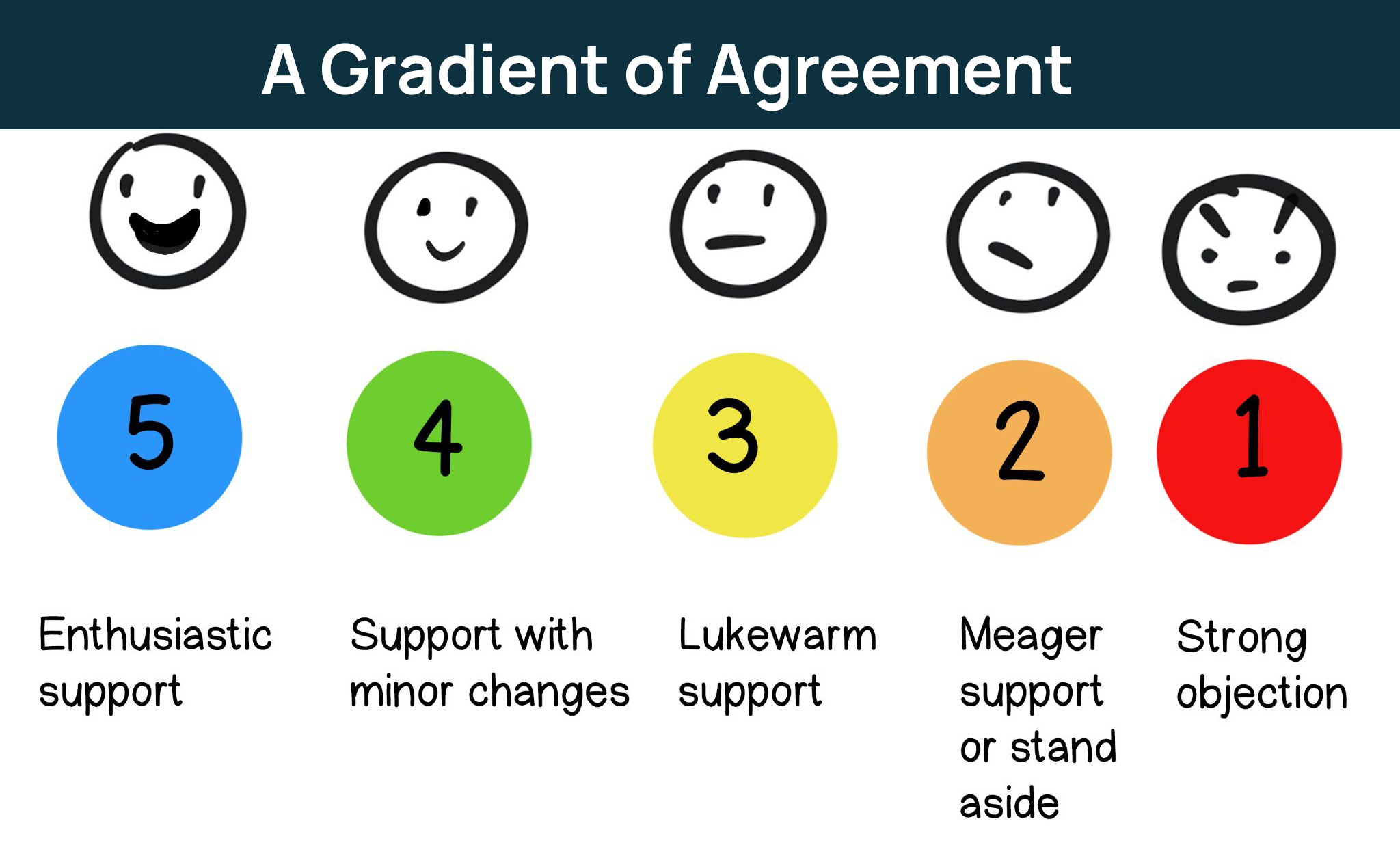
Here’s a more complex version, with more of a gradient, best for groups using consensus.

More consensus strengthening tools from a recent 1-day workshop for a housing cooperative
- rounds
- pair and share
- spectrogram
- setting group guidelines together
- dot voting
- small group work
- marshmellow game and debrief
- visualizations / silent reflection
- working with gradients of agreement
- the process for consensus – 7 steps, done with masking tape on the floor so people could stand on the different parts
- Four Corners exercise about roles we each like to play in groups, by Craig Freshley
- Our outcomes by the end of the day included:
List of shared values – with some prioritization; draft dreams of the co-housing, and a better understanding of what the group needs to have good communication together.
For more resources, visit the online library of Tree Bressen.