
Sahtú Ragóɂa – Drawing 30 hours of Caribou at a Public Listening Session
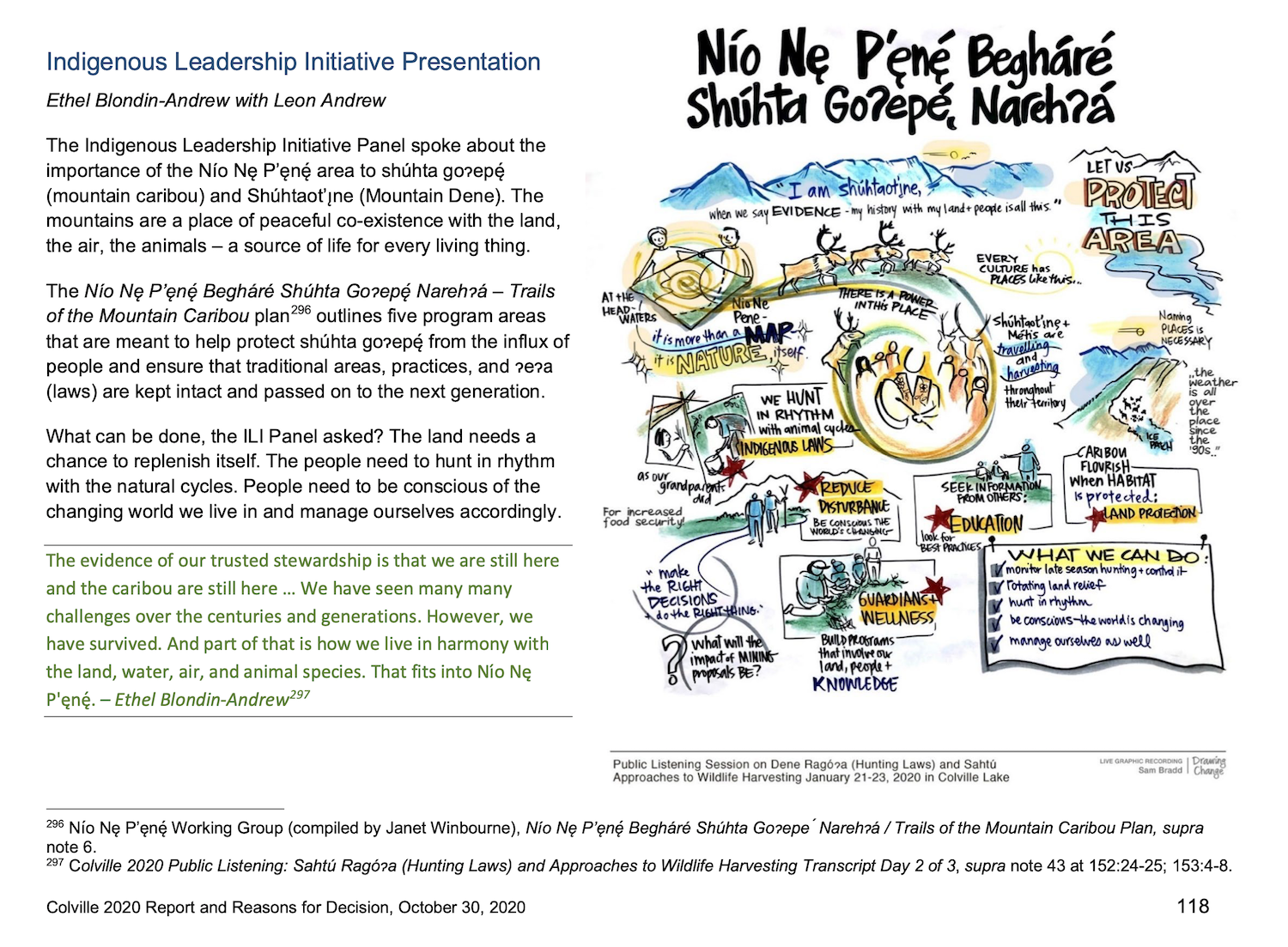
Whenever I now hear the word caribou, I am transported back to graphic recording in a small Arctic gymnasium in Colville Lake. At this Public Listening session, the graphics were verified and submitted as formal evidence in this legal process. It was a first for the Sahtú Renewable Resources Board, and possibly a first elsewhere. In January, for more than 30 hours, Elders, youth, and other experts shared in multiple languages: we heard about caribou, the land, harvesting practices and relationships – since time immemorial.
Graphic recording is public listening — and graphic recording, along with interpreters, were part of the listening at this hearing. I felt the deep responsibility of this project and how to listen well. One unique thing we included during the days of hearings was a process for community consent about the images: we asked presenters about ways to improve the images, and then if they wanted to approve them and enter them into the official evidence.
CBC North also interviewed me while I was in Colville Lake, too, saying “these are probably the coolest conference notes you’ll ever see.”
“They’re probably the coolest-looking conference notes you’ll ever read.
In one, swooping lines pour forth from a map, morph into caribou and encircle a Dene drummer. Beneath them are the words: “It is more than a map, it is nature itself.”
In another, the shores of Great Bear Lake, N.W.T., run beneath a ribbon of words, imploring the reader to “reconnect with the land.”
These notes are the work of graphic artist Sam Bradd. Called “graphic recordings,” the notes summarize three days of presentations on caribou harvest management in Colville Lake, N.W.T., organized by the Sahtu Renewable Resources Board.
“We’re trying to create a visual record,” said Bradd. “This is a type of witnessing.”
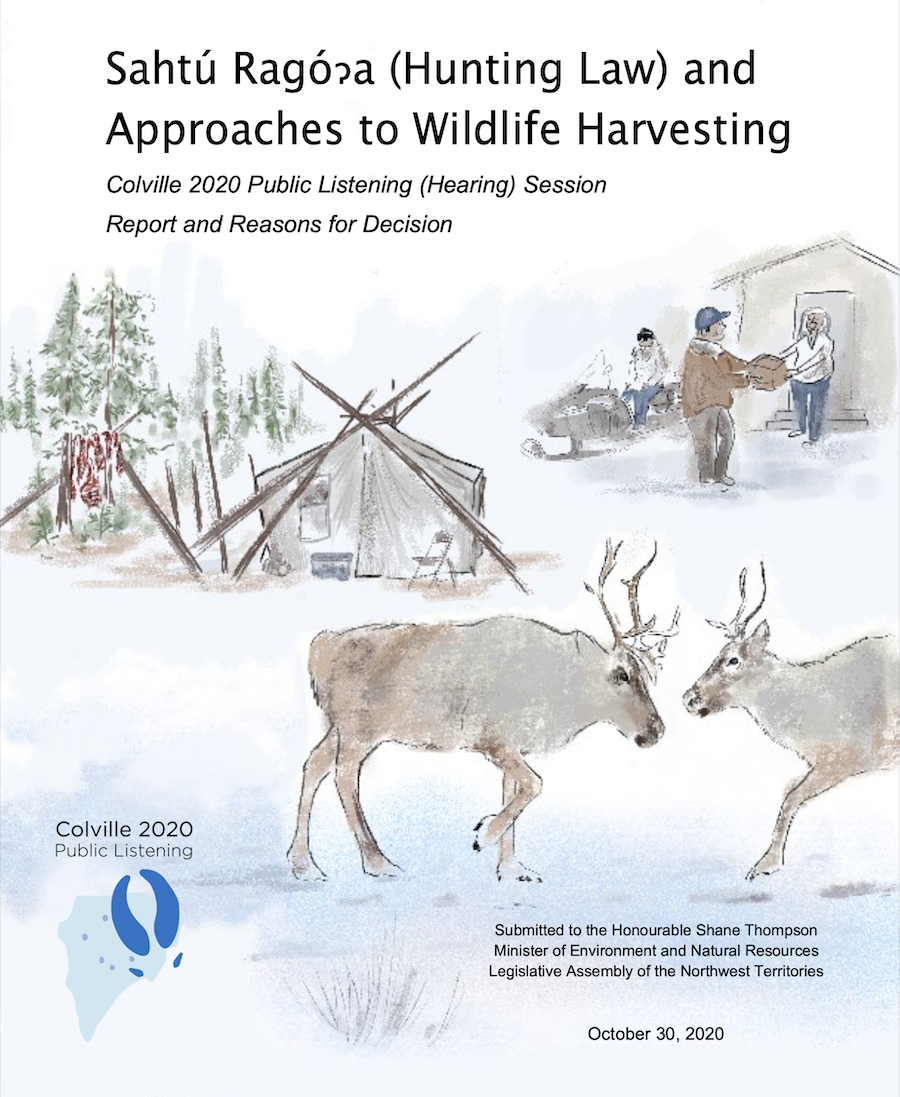
The culmination of the process is now here in the SRRB Board report, just released.




More about the report and process
The present report marks a step in the planned five-part PLS hearing approach undertaken by the Ɂehdzo Got’ı̨nę Gots’ę́ Nákedı (Sahtú Renewable Resources Board – SRRB) during 2020-2024 to address the central question, “What is the most effective way to conserve caribou?” The Colville 2020 PLS focused on the question, “What is the most effective way to regulate the harvest of caribou?”
…
The SRRB is established by the Sahtú Dene and Métis Comprehensive Land Claim Agreement (SDMCLCA) as the main instrument of wildlife management in the Sahtú region. The Minister retains ultimate responsibility for wildlife management, so the SRRB’s decisions are sent to the Minister. The SRRB met and considered the January 29 Minister’s Response. The SRRB also invited hearing parties to comment on legal issues not previously raised before preparing its second report. The SRRB sought to fulfill its mandate by presenting reliable evidence, sound analysis and justified positions.
This report contains two parts: 1) a policy statement on Hı̨dó Gogha Sę́nę́gots’ı́ɂá (Community Conservation Planning – CCP); and 2) the SRRB’s analysis and reply specifically with respect to October 30 decisions and recommendations that the Minister proposed be varied or set aside and replaced.
Publication: Sahtú Renewable Resources Board (Ɂehdzo Got’ı̨nę Gots’ę́ Nákedı), Sahtú Ragóɂa (Hunting Law) and Approaches to Wildlife Harvesting: Report on the Colville 2020 Public Listening (Hearing) Session, 2020 SRRB 1, October 30, 2020, Tulıt́ ’a, NT.