
Inclusive Remote Legal Services


“When you’re looking to increase access to justice, you must first start by asking where.”
Approximately 80% of the clients who go to RISE Women’s Legal Centre have experienced family violence, but they’re often caught in the gap between being ineligible for legal aid and unable to afford legal representation. But RISE is there, with solutions.
Accessible legal services online
RISE is “a community legal centre providing accessible legal services that are responsive to the unique needs of self-identifying women and gender diverse clients, primarily in the area of family law”.
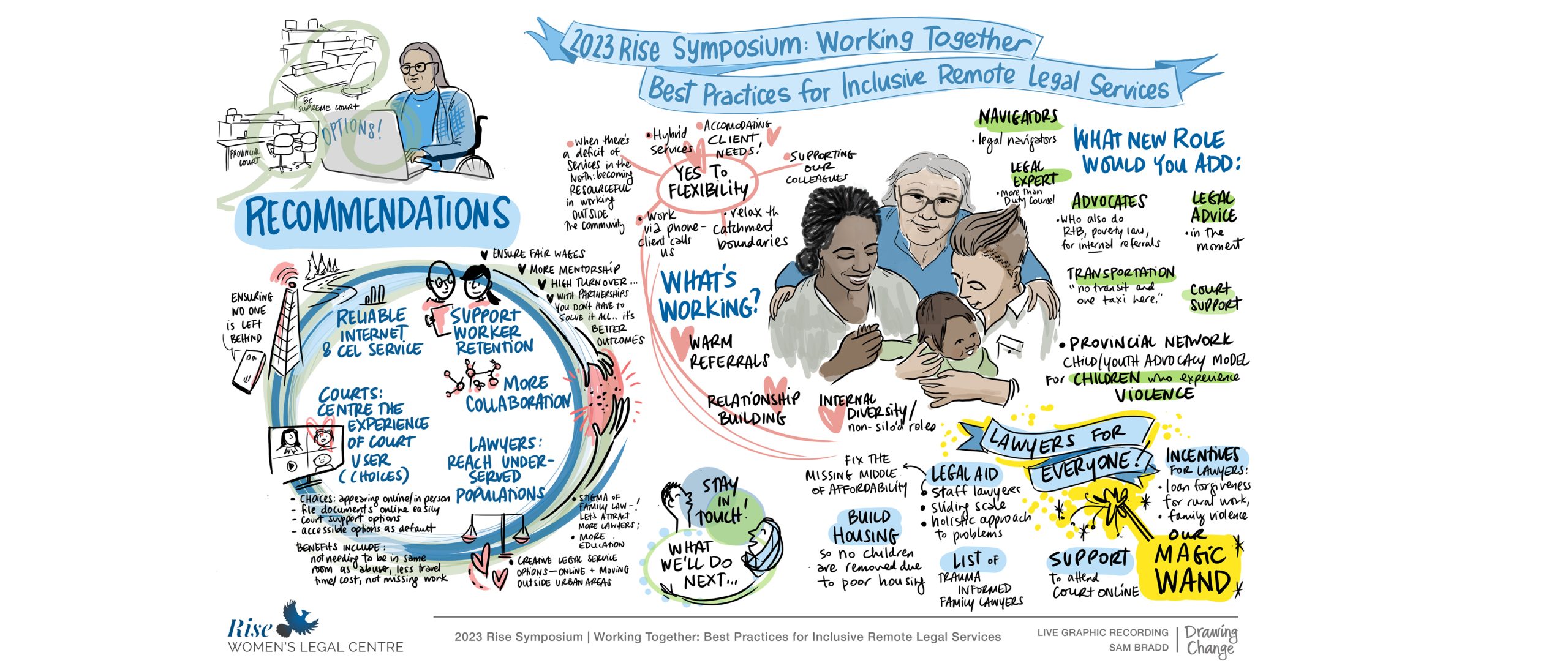
In 2023, as one of the ways to provide accessible legal services, RISE investigated some best practices for inclusive remote legal services in British Columbia. RISE identified many challenges in their report about virtual legal remote services, including the need for flexibility, foundational issues around access, struggles with internet access in remote areas, how law/lawyers need to research and understand the needs of under-served populations, how unique collaborations are key, and centering the voices of people who are affected.
Live graphic recording online
RISE hosted an online symposium to talk about their work about remote legal services, share learnings, and invited live, digital graphic recording to help bring the conversation to life on the screen. Graphic recording summarized the presentations, and during the online breakouts and discussions, graphic recording synthesized the main findings to create a clear, easy to understand record of the conversations.
Methodology for collaboration and centering voices of those affected
What I appreciate about truly thoughtful, great meetings – whether they’re online or in person – is that the process in the meeting can mirror some of the desired change we want to see outside the meeting. Graphic recording makes visual and acknowledges the type of deep listening that’s key to centering the voices of people who are most affected. This methodology at its core, centers deep listening and interrupts top-down ways of sharing knowledge. In this way, we can see how graphic recording is a valuable partner in participatory research and participatory symposia for social change.
Graphic recording, along with conversations and dialogue, shifts the power from just one person presenting and towards recognizing the vast the knowledge that is held in the room. When we’re talking about supporting equitable processes, graphic recording is one more methodology that can amplify voices, attune to deep listening, and support many ways of sharing wisdom that need to be centered in a better, more equitable future.
More about RISE
Find out more about RISE. “In addition to serving clients, we are a knowledge based and knowledge generating organization and work collaboratively with organizations around the province. We:
- provide compassionate and trauma informed legal assistance to our clients,
- teach law students and social work students,
- train lawyers and support workers on how to assist clients who have experienced family violence,
- conduct research into how family violence is addressed through BC’s Family Law Act (FLA) and family law system, with the goal of seeking to improve the experience of survivors in BC.”
“Sam’s work speaks for itself! Sam is attentive, engaged and really hears what the client needs. Sam is open to input and works with you to deliver exquisite and meaningful work.”
Harpreet Kahlon, Education Manager, RISE Women’s Legal Centre